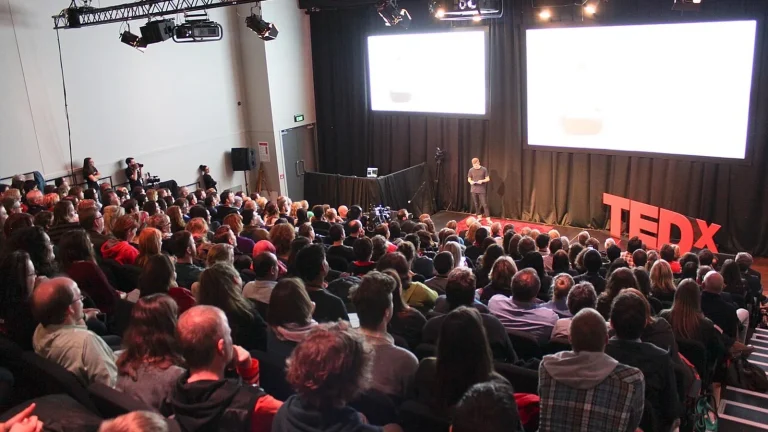
Picture a cybersecurity consultant stepping off a stage in Kansas City after a 40-minute keynote to 300 credit union executives. The applause is long. A line forms. By the time the room empties, she has 11 business cards and a sore hand.
By Friday, she cannot remember which card belonged to the finance chief who asked about her risk assessment, or what she promised to send him.
Quick answer
To turn a keynote into leads, decide the next step before you speak, offer the audience one useful resource tied to your talk, collect contact details with permission, and follow up within days with something specific. Twenty leads from one room is a planning target, not a promise; results depend on audience, fit and follow-up.
Key takeaways
- Leads come from the system around the talk, not from pitching on stage.
- Agree with the organizer, before the event, on what you may offer the audience.
- One useful resource, tied to your core idea, beats a sales slide.
- Follow up within days, and follow email rules such as honoring opt-outs.
- Measure conversations booked, not business cards collected.
Nothing went wrong with that keynote. The talk landed. What was missing was everything around it: a reason for the audience to raise their hand, a way to capture who did and a plan for what happens next.
That gap is common, and it is fixable. This piece lays out a before, during and after plan for turning one keynote into a set of real conversations, without turning the talk into a sales pitch.
What counts as a lead from a keynote?
A lead is not a business card. It is a named person who has a problem you solve, has shown interest and has agreed to hear from you.
That definition matters because it changes what you track. Ten people who downloaded your assessment and three who booked a call are more useful than 40 cards with no context.
For most speakers, keynote leads fall into three groups:
- Buyers: people who could hire you for consulting, coaching or training.
- Bookers: people who could put you on their own stage, internal meeting or podcast.
- Connectors: people who could refer you to either of the first two.
A good plan has a next step for each.
Why do most keynotes end in applause but not pipeline?
Usually because the speaker treats the talk as the whole product. The audience leaves inspired, but with no clear, low-pressure way to go further.
The opposite mistake is just as costly. A talk that turns into a pitch in the last ten minutes can damage the speaker’s reputation with the organizer and the room. Some organizers forbid it outright in their speaker agreements.
The middle path is to make the talk genuinely complete on its own, then offer a single, useful next step that extends it. The value stays on stage. The invitation simply makes it easy to keep going.
Events can drive business when the follow-through exists. In Splash’s 2025 Event Outlook Report, as compiled by Cvent’s 2026 roundup of event statistics, 52% of marketers attributed at least half of their companies’ closed-won deals to their events, and 72% said deals close faster when prospects attend. Those are marketers running their own events, not speakers, but the lesson carries: the event opens the door, and the follow-up walks through it.
What should you set up before the event?
Most of the pipeline work happens before you walk on stage. Four things are worth settling in advance.
- Agree on the rules with the organizer. Ask what you may offer the audience, whether you can show a link or QR code on your final slide, whether the attendee list is shared (often it is not) and whether the organizer will include your resource in their post-event email. Put anything important in writing. Our guide to post-speaking engagement communication covers how to frame these requests.
- Build one resource tied to your core idea. A checklist, a self-assessment, a template or the slides with notes. It should be useful without a sales call.
- Create a simple landing page. One page, one form, a clear description of what people get and a plain statement of how you will contact them.
- Decide your next offers in advance. A short call for buyers, a speaker page for bookers and a referral note for connectors. If you have a workshop or advisory version of your talk, name it and price it before the event, not in the hallway afterward.
How do you invite the audience without pitching?
Make one invitation, once, near the end, and make it about the audience’s next step rather than your services.
A clean version sounds like this: “If you want the self-assessment we walked through today, scan the code or visit this address. It takes five minutes, and it will show you which of the three gaps is costing you most.”
That line works because it is specific, useful and connected to the talk. It is not a discount, a countdown or a list of packages.
A few practical details help:
- Leave the link up. Keep it on screen during Q&A, not just for five seconds before the applause.
- Say it out loud. Some people will not scan a code but will remember a short address.
- Ask the organizer to repeat it. A mention from the emcee or in the event app carries more weight than your own slide.
Speaker Spotlight: Frank Scarso
Frank Scarso, CEO of alternative lender Avanza Capital, which has deployed more than $250 million to small businesses across 48 states, wrote “The Hard Way Home,” a book about losing everything and rebuilding stronger. His story shows how one hard-won narrative can keep opening doors long after it is told.
What should you do in the room after you step off stage?
The 30 minutes after a keynote are the most valuable of the day, and the easiest to waste. People who approach you are self-selecting.
- Stay visible. Stand near the stage or the coffee, not in the green room.
- Ask one question. “What made you come up?” tells you whether this person is a buyer, a booker or a connector.
- Write on the card. One line on the back: what they asked and what you promised. This is the step the consultant in Kansas City skipped.
- Offer the same resource. Point them to the page rather than promising to remember to email them.
How fast should you follow up after a keynote?
Quickly, and with substance. Interest fades fast. Harvard Business Review’s study “The Short Life of Online Sales Leads” looked at how companies handled web inquiries and concluded that most companies are not responding nearly fast enough. A keynote audience is not a web form, but the principle holds: the longer the gap, the colder the conversation.
A simple cadence for the 30 days after a talk:
| When | Who | What to send |
|---|---|---|
| Within 24 hours | Everyone who requested the resource | The resource itself, with a one-line reminder of the talk |
| Within 48 hours | People you spoke with in person | A personal note referencing what they asked, plus what you promised |
| Day 7 | Resource requesters | One short, useful follow-up, such as an example of the framework in use |
| Day 14 | Likely buyers | An invitation to a short call, with a specific reason |
| Day 30 | The organizer | Thanks, a summary of what attendees engaged with and a request for a testimonial or referral |
Do not skip the last row. Our guide to turning client feedback and testimonials into reputation covers how to ask. In AAE Speakers Bureau’s 2024 survey, reported by PCMA’s Convene, attendance was the top success indicator for three in four organizers. Showing an organizer that their audience stayed engaged after the event is a strong case for being booked again.
How do you follow up without breaking email rules?
Marketing email is regulated. In the U.S., the Federal Trade Commission’s CAN-SPAM compliance guide says commercial messages must not use false or misleading header information or deceptive subject lines, must include a valid physical postal address, must give recipients a clear way to opt out and must honor opt-out requests within 10 business days.
In practice, that means:
- Only add people who gave you their details for this purpose.
- Say on the landing page how you will contact them.
- Include your address and an easy unsubscribe link in every marketing email.
- Never upload an attendee list you were not explicitly given permission to use.
Rules differ by country and change over time. If you speak internationally or are unsure, talk to an attorney.
What does the math on 20 leads look like?
Twenty is a planning target, not a benchmark. There is no reliable industry figure for how many leads a keynote should produce, and results swing widely with audience fit, the strength of the resource and the organizer’s support.
Still, working backward helps. Using the room in Kansas City as an illustration only: 300 attendees, a resource relevant to most of them and a clear invitation. If 20 of those people request the resource and say yes to hearing from you, that is about 7% of the room. A handful of in-person conversations, noted properly, sit on top of that.
Then the real question becomes how many of those 20 turn into calls, and how many calls turn into work or new bookings. Track each step:
- Resource requests
- Replies or engaged clicks
- Calls booked
- Proposals sent
- Engagements won, including new speaking bookings
After three or four talks, your own numbers will be worth more than any average.
How do you know a keynote paid off?
Look at the full 90 days, not the night of the event. Some leads take months to mature, and referrals often arrive from people who never filled in a form.
Count conversations booked, revenue or bookings that trace back to the talk and the organizer’s willingness to recommend you. If those numbers are flat, the fix is usually in the resource or the invitation, not the talk itself.
Six months later, the same consultant speaks to a different credit union audience. This time her final slide carries one link to a self-assessment, the emcee repeats it and the back of every card has a note. By the end of the month, she is not holding a stack of cards. She is holding a list of names, each with a problem she knows how to solve and a reason to talk again.
Get featured on Booked Impact
The consultant in Kansas City learned that the talk is only the start. If one of your keynotes turned into clients, bookings or a movement, tell us how it happened and we may feature your story.
Frequently asked questions
Is it okay to sell from the stage during a keynote?
Only if the organizer has explicitly agreed, and even then a hard pitch often damages trust with the audience. Some events prohibit it in their speaker agreements. A single, useful invitation, such as a free resource tied to the talk, usually serves both the audience and the speaker better.
Will event organizers share the attendee list with speakers?
Often they will not, for privacy and contractual reasons. Ask in advance, and do not email anyone on a list unless you have clear permission. Collecting details directly, through a resource the audience requests, is the safer route.
What is the best free resource to offer after a keynote?
The best resource extends your core idea and is useful on its own: a checklist, self-assessment, template or annotated slides. It should take minutes to use and lead naturally to a deeper conversation without requiring one.
Should I use a QR code on my last slide?
A QR code is convenient, but pair it with a short, readable web address and say it out loud, since not everyone will scan. Keep it on screen through Q&A so people have time to act.
How many follow-up emails are too many after a talk?
There is no fixed rule, but a few spaced, useful messages over the first month are usually enough. Every marketing email in the U.S. should include an opt-out, and the FTC's CAN-SPAM guide says opt-outs must be honored within 10 business days.
Sources
- Cvent: 390 Event Statistics Shaping the Industry in 2026
- Harvard Business Review: The Short Life of Online Sales Leads
- PCMA Convene: Survey Explores Speaker and Planner Dynamics
- Federal Trade Commission: CAN-SPAM Act, A Compliance Guide for Business
Read us often? Make Booked Impact Live Editorial a preferred source in Google Search and see our reporting more often in Top Stories.