
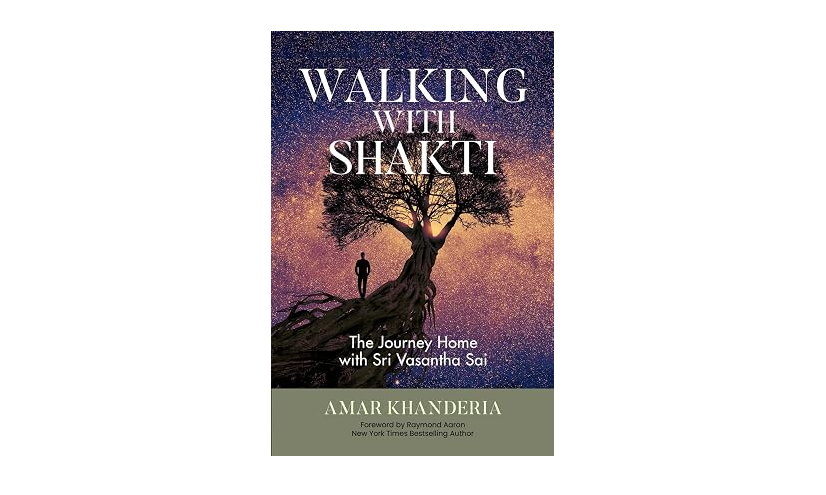
Amar Khanderia spent seventeen years with a teacher in South India. His memoir is best where it admits the work did not go smoothly.
Partway through Walking with Shakti, Amar Khanderia admits he used to hide in his room at the ashram and tell people he was sick. He was not sick. He was, in his own words, “sick of constant growth and transformation.”
That one line does more for the book than any of the miracles in it.
Khanderia grew up in Toronto, finished a business degree, spent a semester on exchange in Copenhagen, then flew to India in 2003 to pay his respects to a teacher and come home to start a career. He stayed seventeen years. The book covers it in nine straight-forward chapters.
The Opening Is the Best Part
Most spiritual memoirs start at the arrival. This one starts with humiliation.
As a teenager, Khanderia loses his faith completely after a canteen conversation turns to a documentary critical of his guru. Grades drop. Friends drift. Years later he is in a Copenhagen dorm with a freshly broken nose and a party still going downstairs, leaning out a window to ask God why he has been forsaken.
Then comes the stretch that had me. Sitting on a roadside curb in South India, broke and nearly out of time, he sees a bus roll past carrying a sign telling him to follow his heart. He calls home to say he is not coming. And then the impossible clears: a free flight change, a stranger in Bangalore with a spare room, a university that allows a final exam by email for the first time. Grace or coincidence, take your pick.
And He Refuses to Make It Look Easy
This is the part I would hand to anyone who thinks the ashram was the soft option. The day ran from 4 a.m. to 9 p.m. Khanderia names what surfaced once he had nothing left to hide behind: anger, jealousy, ego, fear. He admits the place had politics, residents jockeying for closeness to the teacher, and that Amma, his teacher, shut it down: proximity and devotion are two different things.
He is honest about the cost. That is rare in this genre.
Where It Turns
Around chapter seven the book changes who it is speaking to. The first six address anybody. Seven and eight are a devotional portrait: Amma’s biography, the ashram’s founding in 2002, the pillar built in 2006 that the book credits with transmitting vibrations to the world.
Know that going in and stick with it anyway. Because this is the closest look at Amma you’ll get in the whole book. The miracles do stack here, a prayer, a coincidence, a confirmation, repeat, and they ask more of a sceptical reader than the early chapters did. Khanderia also raises his own best question and lets it go. He mentions in one line that daily proximity had begun to make him see Amma as just another person. It’s the most interesting sentence in the book.
Why It Is Still Worth Your Time
Because it corrects something. If your picture of a spiritual retreat is candles and calm, this book swaps it for a 4 a.m. start, a bedsheet on a tiled floor, and a man wrestling with the ego underneath his anger, jealousy, and fear. He had nowhere to put any of it for years. It becomes real and worth knowing whatever you believe.
Then there is the one idea that will outlast the book for you. When Khanderia complains that his progress keeps circling, Amma hands him seven mountains: you come down the first before you climb the second, so the stretch that feels like falling is the approach to the next rise. Anyone in a plateau right now can use that this week.
The four lessons he closes on hold up as instruction. Release the need to control outcomes. Speak less. Stop taking the whole thing so seriously. Watch your reactions without judging them. He illustrates the last one in a bubble tea shop, noticing a wave of mental noise arrive and deciding to watch it like an afternoon film. This is a better tool than most books twice the length.
And it is 120 pages. Two sittings, and almost every page holds a scene hidden with a lesson.
4 out of 5
Warm, specific, and unusually honest about the tedium of a path that normally gets sold on its peaks. It leans hard into testimony in the back third, and the reader who arrives sceptical may not leave convinced, but leaves with more possibilities to sit with.
One more thing. The author bio ends by noting that his best friend is a tree. No explanation offered. Feels humanly humorous. I loved that.
Read it for what a long apprenticeship actually costs day to day. Just know you are reading from inside the belief, not about it.
Read us often? Make Booked Impact Live Editorial a preferred source in Google Search and see our reporting more often in Top Stories.